
In some odd specific scenarios, you may get alerted by our platform that your domain is about to expire, even though your Domain Registrar shows you an expiry date long into the future (i.e., in a year from now).
This happens because our system checks your domain’s actual expiration date, as it appears at the Internet Corporation for Assigned Names and Numbers (ICANN).
Your Domain Registrar can claim they’ve already renewed your domain name before actually doing so.
If you look up your domain name in ICANN’s whois database, then you can see the actual expiration date: https://lookup.icann.org/en/lookup
Demo Example:
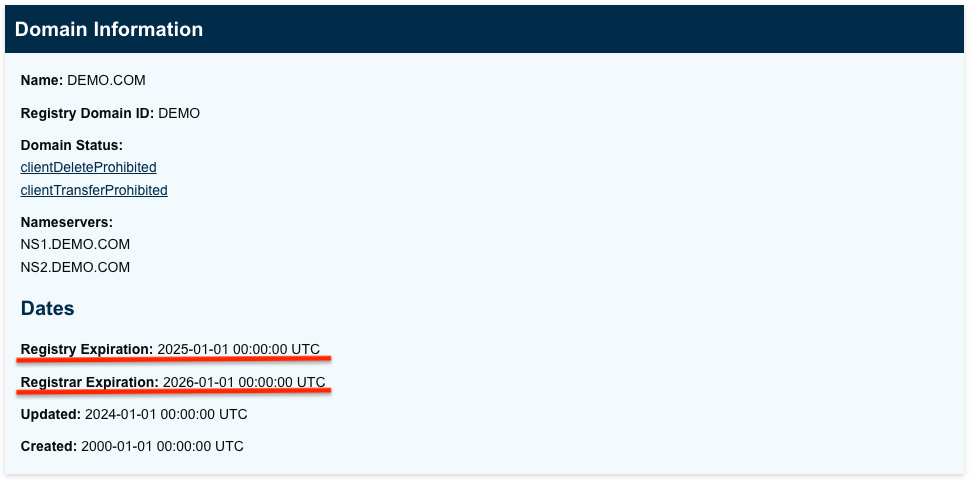
- Registry Expiration Date – This is the expiration date stored at the TLD registry (e.g., Verisign for .com). It reflects when the domain is supposed to expire at the registry level, based on the current registration term that has been pushed to the registry.
- Registrar Expiration Date – This is the expiration date shown by your registrar (GoDaddy, Namecheap, etc.). It reflects what you have already paid for / renewed, even if that renewal has not yet been submitted to the registry.
In the example above, you have paid the registrar till 1st of January 2026, but officially, the domain is still set to expire on the 1st of January 2025.
Why does this happen?
Registrars do not always push future renewals immediately to the registry.
Common reasons:
- They batch renewals to reduce registry fees
- They wait until closer to the expiration date
- ICANN allows registrars to “hold” prepaid years internally
Until the registrar submits the extra year to the registry, WHOIS will show this mismatch.
In most cases, this is nothing to worry about, as your Domain Registrar will actually renew your domain before it expires. However, in such cases, the expiration date for your domain name in their panel is incorrect, while the expiration date presented by our system is correct, which is where the discrepancy appears.